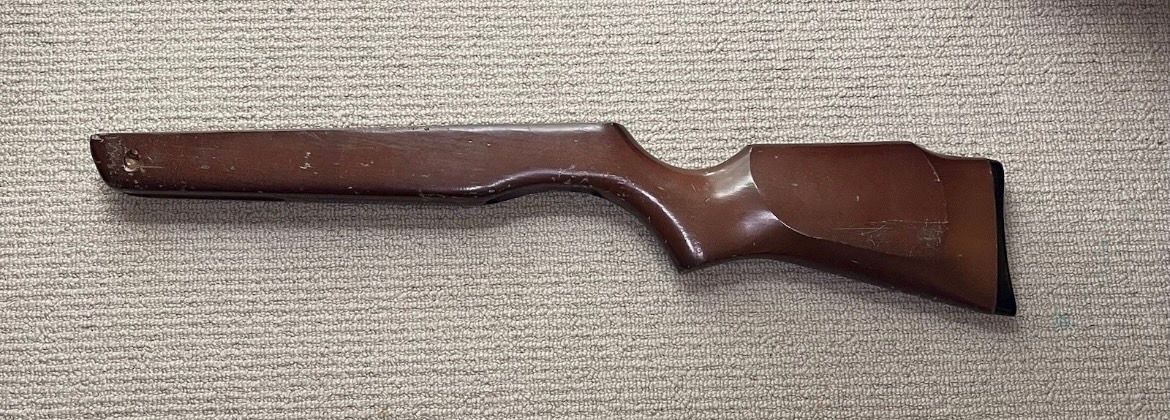
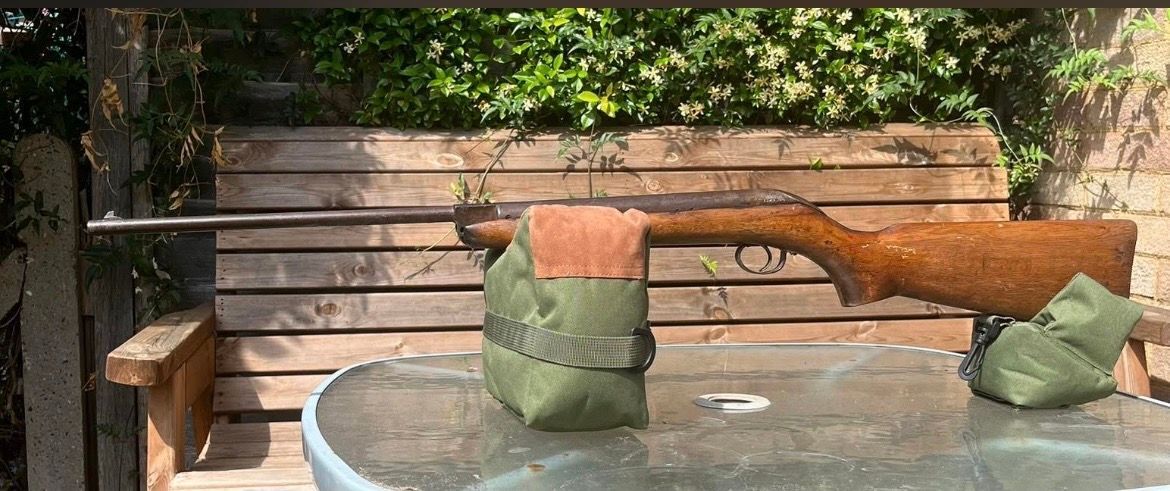
Diana Model 1

Paul Angel • October 24, 2026

The Diana model 1 tin plate air pistol 1924 to 1935 history ownership and collectability.


Introduction.

The early Diana Model 1 is an interesting example of pre-war German airgun manufacture. Produced by Mayer & Grammelspacher, the company behind the famous DIANA brand, it was a simple spring-powered pistol designed for recreational shooting. Its lightweight, pressed-metal construction reflects a time when airguns were intended to be affordable and straightforward. Today, surviving examples are of interest to collectors who appreciate early airgun design and the history of Diana.


A Brief History.

Mayer & Grammelspacher was established in Rastatt, Germany, in 1890, with the DIANA brand introduced in 1905. The Model 1 belongs to the early development of the company's air pistols. However, precise production dates can vary between versions, and individual examples should be assessed by their markings and construction.


The Second World War and Manufacturing Rights.

Following the Second World War, the original Diana factory was dismantled in 1947, and equipment, tooling, designs and the DIANA name passed to British company Millard Brothers. Production subsequently began in Scotland under the Milbro name and using the Diana brand. Meanwhile, the original German company rebuilt its business in Rastatt from 1950, using alternative names such as Original and Original Diana in markets where the DIANA trademark was unavailable. The German company reacquired the DIANA trademark in 1984.


This history is important when identifying early pistols. A Diana marking alone does not establish the country of manufacture, and pre-war German examples should not be confused with later British-made versions.


Basic Construction.

The Model 1 uses a conventional spring-powered mechanism, with no CO₂ cartridge or separate pumping system. Its main components include: Pressed-metal body: Lightweight and economical to manufacture. Barrel assembly: The passage through which the projectile travels; bore type should be checked on the individual example. Spring and piston: Store mechanical energy and compress air when the pistol is fired. Trigger mechanism: Releases the cocked mechanism and Grip panels and sights: Provide the holding surface and basic aiming arrangement. After more than 90 years, corrosion, worn components and previous repairs may affect both safety and originality. Original markings, grips and finish are worth preserving.


Availability of Spare Parts.

Finding original Model 1 parts can be difficult because production ended many decades ago. Springs, seals, grips, pins, trigger components and barrel-related parts may only be available through specialist collectors, old stock or donor pistols. Do not assume that parts from later Diana or Milbro models will fit. Similar appearances do not guarantee compatibility. For collectors, an incomplete or non-working pistol may still be useful as a source of original components. Correct identification is essential before purchasing parts or a donor example.


Rarity and Collectability.

The pre-war Model 1 is an appealing collectible for enthusiasts interested in early German airguns and the development of the Diana brand. Its age, pressed-metal construction and historical connection to the post-war division of production make it particularly interesting. However, age alone does not establish rarity, and reliable production figures for individual variants are not readily established.

Collectors should look for: Correct pre-war German identification and markings, Original grips, finish and components, A complete mechanism, even if it needs attention. Minimal alterations and evidence of previous repairs. Original packaging or documented provenance, where available.


An honest, original example can be more desirable than a heavily restored pistol that has lost its period character.


Buying and Owning One Today.

Ask for clear photographs of the markings, grips, barrel assembly and any damaged areas. Check whether components appear original and whether the seller can provide a history of the pistol. A gun that cocks or fires is not necessarily safe, while a non-working example may still be worth preserving. In the UK, do not assume that age alone makes an air pistol exempt from firearms legislation. Establish its legal classification and the relevant requirements before buying, selling or arranging delivery.


Final Thoughts.

The Diana Model 1 represents an important part of early recreational airgun history. Its simple construction and pre-war German origins make it an interesting pistol for collectors, while its age presents challenges in maintenance and parts sourcing. Correct identification, careful preservation and responsible ownership are the best ways to protect these historic examples for future generations.


Angel Air Parts – preserving the parts, history and knowledge behind classic air guns.


By Paul Angel • October 9, 2026
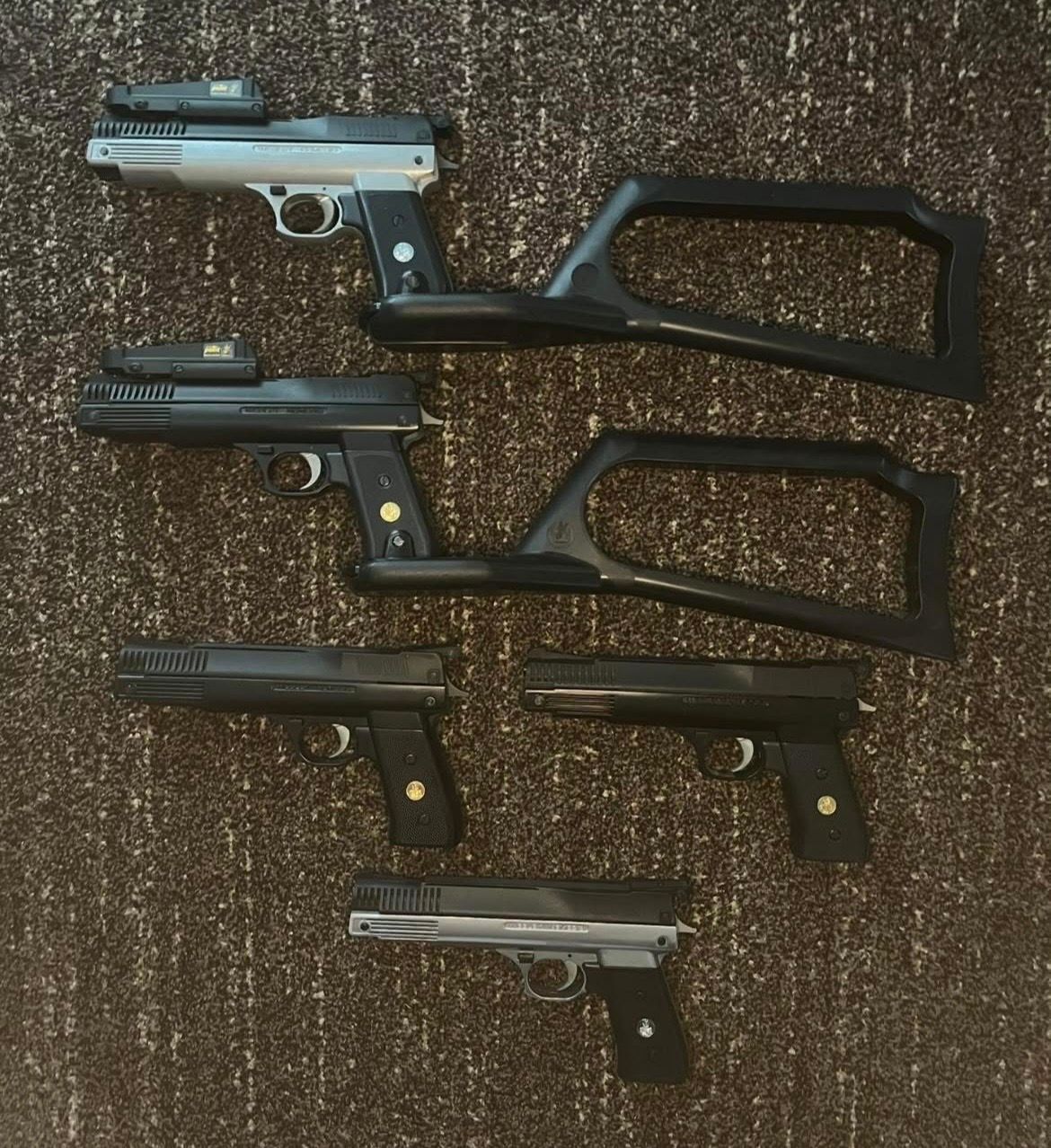
The Webley Nemesis Air Pistol - A Forgotten Classic of Modern Webley Manufacture. Among Webley & Scott’s later air pistols, the Nemesis is perhaps one of the most overlooked. Introduced in 1994, it represented a significant departure from the traditional all-steel air pistols that had established Webley’s reputation, yet it remains an interesting and distinctive addition to any collection. With its unusual design, single-stroke pneumatic action and a range of finishes, the Nemesis deserves considerably more attention than it receives. Production and History. The Webley Nemesis was manufactured from 1994 until the closure of Webley’s Birmingham factory in 2005. Alongside the Hurricane, Stinger and Tempest, it formed part of the final generation of air pistols produced by Webley & Scott in England. Designed by Chris Dunn and Harold Resuggan, the Nemesis was developed during a period when the airgun market was changing. Modern designs, new materials and alternative power systems were becoming increasingly popular, and Webley needed to remain competitive. For traditional Webley collectors, the move away from the solid-steel construction of earlier models was not universally welcomed. However, the market was moving forward, and the Nemesis demonstrated Webley’s willingness to embrace new ideas while retaining its own identity. A Different Approach – Single Stroke Pneumatic Power. Although the Nemesis shares some of the general layout of other Webley pistols, its power system is fundamentally different. Rather than relying on a conventional mainspring, the Nemesis uses a single-stroke pneumatic (SSP) mechanism. Opening the barrel assembly draws air into the compression chamber. Returning the assembly to its closed position compresses that air, ready for firing. When the trigger is pulled, a valve releases the stored air to propel the pellet. This arrangement offers two notable advantages. Firstly, the absence of a heavy spring being released reduces the mechanical disturbance associated with firing. Secondly, the trigger mechanism does not have to release a powerful mainspring, contributing to a lighter and more refined firing experience. The result is a pistol with a notably different character from the traditional spring-powered Webley's. Its firing cycle is comparatively smooth and free from the pronounced movement associated with many spring-piston designs. Construction and Design. The Nemesis combines metal components with alloy and plastic mouldings, reflecting the manufacturing methods and design priorities of the period. Its substantial frame gives the pistol a somewhat bulky appearance, while the grips have a pronounced, almost Browning-like feel. The ergonomics are quite different from those of the classic Webley Senior or Premier, and the Nemesis will appeal to some hands more than others. The pistol also incorporates a grooved mounting provision for an optional telescopic sight. This added versatility made the Nemesis suitable for a variety of target-shooting applications. Although its appearance divided opinion, the design was practical and contemporary for its time. The Nemesis was not intended to be a reproduction of a classic Webley; it was an attempt to produce a modern sporting air pistol under a famous British name. Finishes, Colours and Special Editions. One of the most interesting aspects of the Nemesis is the variety of finishes in which it was produced. These variations provide collectors with an additional challenge, particularly when searching for examples in original condition. The principal finishes and reported variations include: Black: The standard finish, giving the pistol a conventional sporting appearance. Early black examples used an electrophoretic coating, while later production moved to an epoxy-type finish. Bright Silver: Introduced in September 1994, this finish gave the Nemesis a distinctly different appearance from the standard black model. Bright Silver Special Edition: A special-edition version associated with the National Exhibition Centre show in October 1994. Grey or Dull Silver: Introduced in 1996, offering a more subdued alternative to the bright silver finish. Red, Yellow, Orange and Green: Coloured versions introduced in January 1996. Gold-plated presentation examples: Particularly desirable collector’s pieces, with reports of extremely limited production. The coloured Nemesis pistols are especially intriguing. Their introduction was partly prompted by the Pony Club, which wanted pistols for shooting events at gymkhanas that looked less like conventional firearms. The bright colours provided a more appropriate appearance for these events and allowed different teams to use different colours. Production of the coloured versions ceased in December 2000. They were produced in relatively small numbers, and examples in good original condition are now particularly interesting to collectors. The gold-finished presentation pistols are another fascinating part of the Nemesis story. Very few are known, and examples accompanied by their original presentation cases are especially desirable. Collectors should exercise caution when identifying unusual finishes. A bright silver example, a special-edition pistol and a gold-plated presentation piece are not necessarily the same variant, and original finish should always be distinguished from later refinishing. The Aim Brace – Turning the Nemesis into a Carbine. An unusual accessory available for the Nemesis was the Aim Brace. This attachment allowed the pistol to be converted into a carbine-style configuration, providing additional support and a different shooting experience. Importantly, the accessory was designed to fit without drilling the pistol. This was a useful advantage over certain other Webley accessories, where fitting could involve permanent alteration. For collectors, an original Aim Brace is an interesting accessory in its own right, particularly when accompanied by its original packaging. As with many accessories produced for older airguns, finding one today can be more difficult than finding the pistol itself. Original Packaging. The Nemesis was supplied in more than one type of packaging during its production life. Early examples were available in a distinctive clear plastic clam-shell pack. These are particularly attractive to collectors because they display the pistol and its finish, although the plastic can become discoloured, brittle or damaged with age. When supplies of the clam-shell packaging were exhausted, Webley moved to a plain brown cardboard box with a polystyrene insert. This change took place around 2003–2004. Original packaging can add considerably to the appeal of a complete example, particularly for the less common coloured and special-edition models. However, packaging alone should not be treated as definitive evidence of a pistol’s age or originality. Maintenance and Ownership The Nemesis is now an older air pistol, and age-related deterioration should be considered before purchasing one for regular use. Its pneumatic action avoids the conventional mainspring system, but it still relies on seals, valves and other components to retain and release compressed air correctly. A pistol that has been stored for many years may require professional inspection before being returned to service. Original finishes and plastic components also deserve careful treatment, as unnecessary dismantling or aggressive cleaning can permanently reduce a collector’s value. Five Things to Check When Buying a Webley Nemesis. Air retention and performance: A loss of power or an inability to retain air may indicate deterioration of internal seals or valve components. A pistol’s external condition does not necessarily reflect the condition of its pneumatic system. Breech and sealing surfaces: Inspect the breech area and accessible sealing surfaces for damage, deterioration or signs of previous interference. Poor sealing can affect performance. Barrel assembly and locking mechanism: Check for excessive play, damage or signs that the barrel assembly does not close and lock correctly. Wear around moving components can affect both operation and consistency. Trigger and safety: The trigger and safety should be checked for correct operation. Any uncertainty about their function warrants examination by a suitably qualified airgun technician. Condition, originality and previous repairs: Look carefully at the finish, grips, mouldings and fastenings. Signs of rough dismantling, replacement components or refinishing may affect both value and originality. On coloured and special-edition models, preserving the original finish is particularly important. These are inspection points rather than a claim that every Nemesis suffers from the same faults. A well-preserved example may remain in excellent condition, while another of similar age may require considerable attention. Internal repairs should be left to someone experienced with the Nemesis mechanism. For collectors, retaining original components and avoiding unnecessary modifications is always preferable. A Collectable Webley Worth Rediscovering. The Webley Nemesis occupies an interesting position in the company’s history. It represents the transition from the traditional steel-bodied Webley air pistol towards the more modern materials and mechanisms that were becoming increasingly common during the 1990s. Its single-stroke pneumatic action, distinctive styling, optional Aim Brace and unusual range of finishes make it much more than simply another late-production Webley. For collectors, the coloured Pony Club models, silver special editions and gold-plated presentation examples provide additional reasons to seek out this often-overlooked pistol. Original packaging and accessories can make an already interesting example considerably more appealing. Although it may never enjoy the same universal recognition as the Senior, Premier or Tempest, the Nemesis remains an important part of Webley’s later Birmingham production history. For Angel Air Parts, it is a reminder that the history of classic airguns does not end with the traditional designs. The later models, their accessories and the parts that keep them functioning are equally deserving of preservation. Angel Air Parts – preserving the parts, history and knowledge behind classic air guns.
Black Walther pistol with brown checkered grip on a stone surface
By Paul Angel • October 2, 2026
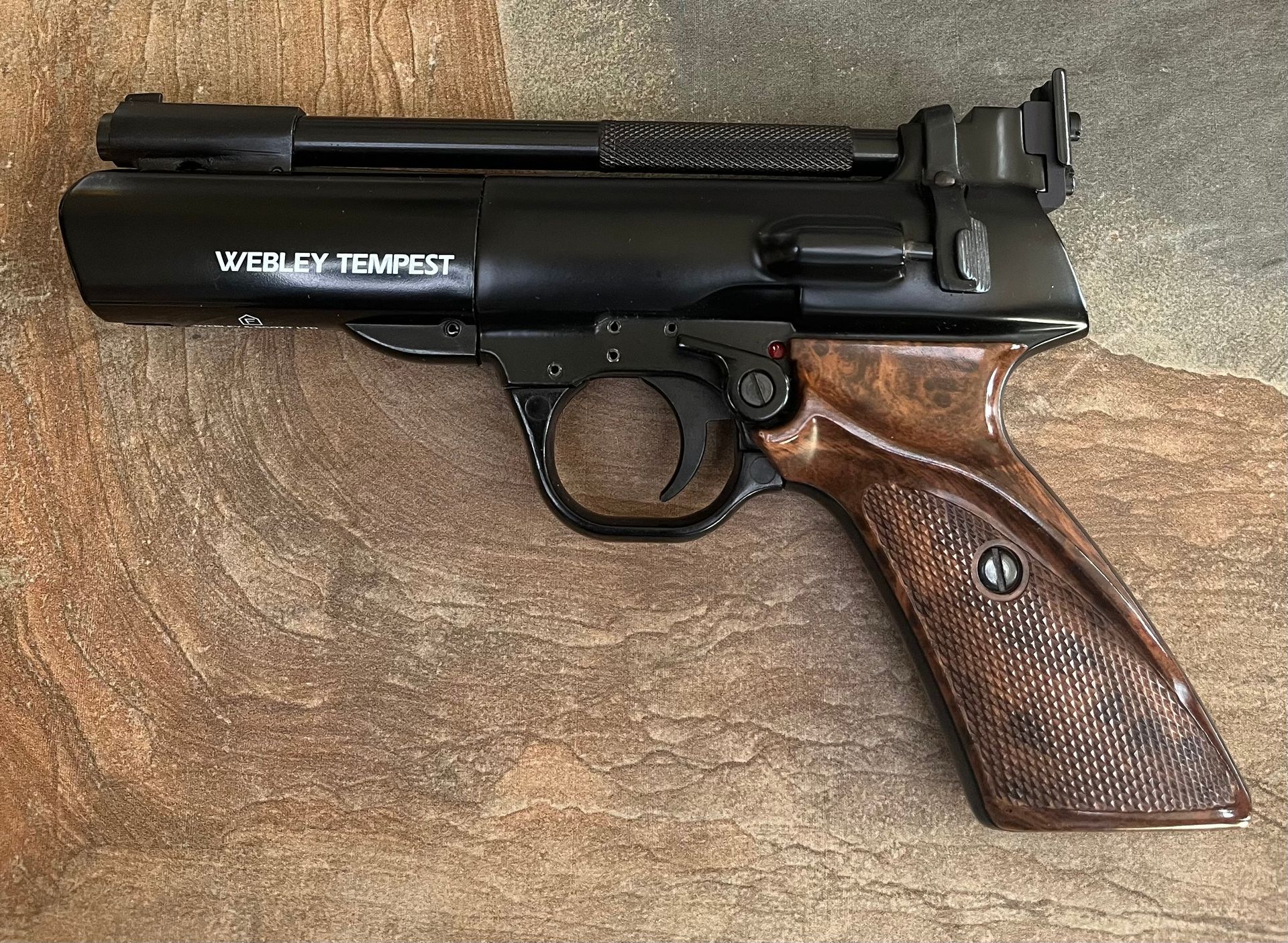
The Webley Tempest is one of the most recognisable modern Webley air pistols and, for many owners, one of the most nostalgic.  Introduced in 1979, the Tempest brought a more traditional, compact appearance back to the Webley range following the introduction of the Hurricane and Typhoon. It combined a familiar Webley profile with a break-barrel action, adjustable sights and a compact grip. For many collectors, the Tempest remains the Webley they remember from their younger days: a distinctive pistol that has stood the test of time. The Birmingham Tempest – 1979 to 2005 The original Birmingham-made Tempest was produced from 1979 until the end of Webley's Birmingham manufacturing era in 2005. The design followed the traditional Webley principle of a spring-piston mechanism housed within a compact alloy-bodied pistol. The barrel breaks open for cocking and loading, while the familiar Webley stirrup locking arrangement secures it for use. Typical factory specifications include: Calibres: .177 and .22. Overall length: approximately 9.12 inches (232 mm). Barrel length: approximately 6.89 inches (175 mm). Weight: approximately 2 lb (0.9 kg). Action: single-shot, break-barrel, spring-piston. Sights: fixed foresight and adjustable rear sight. Other features: manual safety and adjustable trigger. These figures are general reference specifications and may vary between versions. Why the Tempest was different. The Hurricane had a longer, more unusual appearance, with an extended sighting arrangement that gave it a rifle-like character. The Tempest returned to a more conventional pistol layout, making it visually distinct while retaining much of the same design philosophy. The Tempest was compact enough to be marketed as a "pocket pistol", although this was advertising language rather than a recommendation to carry an air pistol in a pocket. Identifying and dating a Birmingham Tempest. One of the most useful features for collectors is the wording on the pistol's fore-end or shroud. Early production – approximately 1979 to 1981. Early examples carry the simpler TEMPEST marking. Factory identification is associated with earlier Birmingham wording, including "WEBLEY & SCOTT LTD BIRMINGHAM ENGLAND" on the underside of the fore-end. Later Birmingham production – approximately 1981 to 2005 The marking changed to WEBLEY TEMPEST , accompanied by revised factory identification, including "WEBLEY & SCOTT LTD MADE IN ENGLAND". These changes provide a useful starting point when comparing pistols. However, they should be treated as approximate identification clues rather than a precise dating system. When examining a Tempest, consider: The exact wording and location of factory markings. Whether the pistol is marked as made in England or Turkey. The calibre and condition of the original components. The grip and fore-end design. Any surviving original paperwork, instructions and packaging. The Tempest should not be dated by simply applying the serial-number or batch-number methods used for many older Webley steel-bodied pistols. A number on an individual component does not necessarily provide a straightforward manufacturing year. For additional background, see the Angel Air Parts guide, A First Guide to Webley Air Pistol Dating. Grips, sights and cosmetic variations. The Tempest was available with plain black synthetic grips, while more decorative wood-effect plastic grips were also offered. These variations are worth noting when comparing examples, particularly boxed pistols. However, a different grip does not necessarily indicate a different production year, and replacement grips may have been fitted during the pistol's lifetime. The adjustable rear sight is another important component to inspect. Missing sight elements, damaged adjustment screws or evidence of alterations can affect both usability and collector appeal. Originality matters, particularly for early Birmingham examples. A clean, original pistol will often be more attractive to a collector than one that has been heavily refinished or modified, even if the latter looks cosmetically impressive. From Birmingham to Turkey. The end of Birmingham production in 2005 marked a significant change in Webley's history. Later Tempest pistols were manufactured in Turkey, with production commonly associated with the period from around 2011 onwards. Although the later pistols retained the familiar Tempest appearance, they should not automatically be considered identical to the earlier British-made models. Differences in construction, component dimensions and fittings can affect compatibility. Some replacement components may differ between Birmingham and Turkish versions, making identification particularly important when sourcing spare parts. An important point for owners: establish which version you have before ordering replacement components. A part advertised simply as "Webley Tempest" may not fit every production variant. When sourcing spares, provide photographs of the pistol, its markings and the component required. Measurements and identifying numbers can also help establish whether a part is suitable. The Tempest Finale. The Tempest Finale was marketed as a limited edition, with a reported worldwide production of 800 pistols across .177 and .22 calibres. It retained the recognisable Tempest layout but was presented as a special closing edition of the classic design. Its limited production makes it an interesting variation for collectors, particularly when accompanied by original packaging and documentation. Before paying a premium, check the specific edition markings and confirm that the pistol is complete and correctly represented. The Tempest Centennial. The Centennial Tempest is a separate collector variation associated with the 100th anniversary of Webley's first airgun patent in 1910. A 2010 edition was produced in a special presentation case, with numbered examples and accompanying documentation. Published auction descriptions identify a worldwide production of 2,000 pistols. The Centennial should not be confused with the Finale. They are distinct editions, and their markings, presentation cases and accompanying paperwork are relevant to identification. For collectors, the condition and completeness of these presentation sets can be as important as the pistol itself. Packaging and accessories. Over its production life, the Tempest appeared in different forms of packaging, including polystyrene inserts with cardboard lids and later presentation-style cases. The Turkish-era Centennial edition introduced a distinctive presentation case, while other later examples may be found with different packaging. Original instructions, certificates, accessories and packaging can increase a pistol's appeal, especially when everything remains together. Nevertheless, a box is supporting evidence rather than proof of age or originality. Packaging can be swapped, and pistols may have been reunited with boxes from different examples. For collectors, the strongest evidence comes from consistent markings, believable condition, appropriate documentation and a clear understanding of the model concerned. Five common Tempest problems A Tempest may now be several decades old, so age-related deterioration is worth considering even when the exterior looks excellent. 1. Worn piston seal A deteriorated seal can contribute to reduced or inconsistent performance. Poor performance does not automatically mean that the mainspring needs replacing; several internal components may require assessment. 2. Mainspring deterioration After many years, the mainspring may weaken or become damaged. Cocking feel and performance can change, but these symptoms should be assessed alongside the condition of the seals and other components. 3. Breech seal deterioration The breech seal can harden, flatten or become damaged over time. This may allow air to escape when the pistol is fired. 4. Barrel locking mechanism wear The Tempest's barrel locking arrangement is an important part of its design. Excessive wear, damage or an unreliable lock should be treated seriously. Do not use a pistol if the barrel fails to lock securely. Have the mechanism inspected by a suitably experienced airgun specialist. 5. Sights, safety and trigger problems Rear sights can become loose or damaged, while dirt, wear or previous incorrect adjustment can affect the safety and trigger mechanisms. Avoid attempting to correct trigger problems through indiscriminate adjustment. If the safety or trigger does not operate reliably, stop using the pistol until it has been inspected. General maintenance and ownership. The Tempest benefits from sensible routine care rather than unnecessary dismantling. Exterior care: Wipe the pistol with a clean, soft cloth after handling. Keep metal surfaces dry and use only a suitable, light protective treatment where appropriate. Lubrication: Avoid excessive oil or grease. Incorrect lubrication can cause problems, and unsuitable petroleum-based products should not be introduced into the compression chamber. Storage: Store the pistol in a dry environment to reduce corrosion and deterioration of grips, seals and packaging. Keep it securely stored and inaccessible to unauthorised people. Routine inspection: Look for corrosion, damaged grips, loose sights, deterioration around the breech and signs of previous repairs. Check for visible damage to the barrel locking arrangement without forcing or adjusting it. Internal servicing: Spring-piston mechanisms contain components under tension. If the pistol needs internal servicing, use a competent airgun specialist familiar with the relevant version. With an older Tempest, originality is worth preserving. Replacing worn consumable components is often sensible, but unnecessary refinishing, modification or substitution of original parts can reduce collector interest. How much is a Webley Tempest worth? Values depend on condition, functionality, calibre, originality, production version and whether the original box and accessories survive. UK auction results can provide useful reference points. For example, a boxed Tempest was reported sold for £147 at Holts in December 2025, while a cased Centennial-related example with custom grips was reported sold for £320 at Wilson55 in April 2026. The latter was a special presentation example and should not be treated as representative of a standard Tempest. These examples illustrate why it is important to distinguish an ordinary pistol from a complete or unusual collector's example. Indicative UK collector values. The following are broad guide estimates, not guaranteed sale prices or formal valuations. Condition or versionIndicative valuePoor condition, incomplete or requiring repair£30–£60Fair, used example with visible wear£50–£85Good, complete Birmingham Tempest£75–£120Very good, original example£100–£150Very good boxed example with accessories£130–£200Particularly clean early example or desirable variation£150–£225+Finale or Centennial presentation example£175–£300+, depending on completeness and demand These ranges overlap deliberately. A boxed pistol with damaged components may be worth less than an unboxed example in excellent original condition. Exceptional presentation sets or unusual variations can exceed the guide, but premiums should be supported by comparable sales. Auction hammer prices are not the same as a dealer's retail asking price. Buyer's premiums, delivery arrangements and the cost of any required servicing should be considered when comparing results. For Angel Air Parts, the distinction between collector value and parts value is also important. A pistol purchased for dismantling needs to be assessed according to the condition and resale demand of its individual components, rather than simply its potential value as a complete example. Why the Tempest remains popular More than four decades after its introduction, the Tempest continues to occupy an interesting position in Webley's history. It offered a more compact alternative to the Hurricane, retained the company's familiar design character and remained in production through a period of significant change. Its later Turkish production and special editions added further chapters to the story. For some owners, the Tempest is simply an enjoyable piece of traditional airgun design. For others, it represents a first air pistol, a remembered shooting experience or a particular period of British manufacturing. Its continuing appeal lies in that combination of recognisable styling, practical engineering and nostalgia. For collectors and restorers, understanding the differences between production versions is especially important. Correct identification helps preserve originality, supports sensible purchasing decisions and ensures replacement parts are selected with care. At Angel Air Parts, we believe maintaining these older pistols is about more than keeping an item in working order. It is also about preserving the knowledge, components and history that make each model worth remembering. Angel Air Parts – preserving the parts, history and knowledge behind classic air guns.

By Paul Angel • October 1, 2026
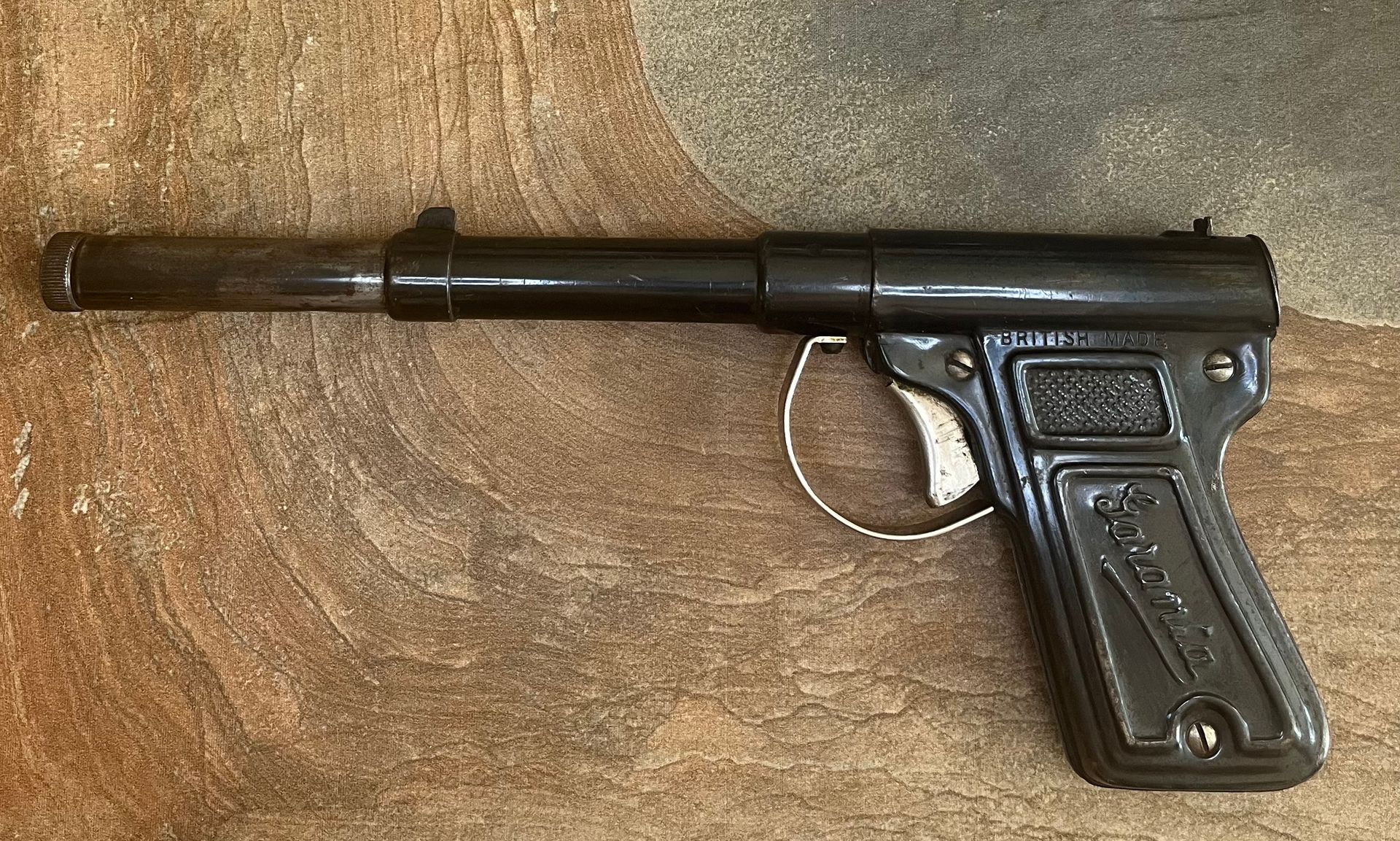
Garanta. Among the many inexpensive pop-out air pistols produced during the early 20th century, few are as intriguing to today's collector as the Garanta. At first glance, its simple pressed-steel construction makes it look like just another inexpensive push-barrel air pistol. However, surviving examples are now considered particularly scarce. An Early British Pop-Out. The Garanta was certainly being sold in Britain by 1933, when it appeared in a Joseph Bourne & Son wholesale trade catalogue. Modern specialist descriptions generally date examples to approximately 1933–1939, placing the Garanta firmly within Britain's pre-war airgun era. A main dealer describes the pistol as a British-made .177 sheet-steel push-barrel air pistol. Who Made the Garanta? This remains one of the Garanta's biggest mysteries. Although marked “British Made”, the actual manufacturer has never been conclusively identified. There has been speculation among collectors that the Garanta may be related to other British pop-out pistols such as the Briton and Limit, but these theories remain unconfirmed. For the moment, the safest description is simply: Garanta – British Made, manufacturer unknown. The Design. The Garanta uses the familiar push-barrel or pop-out cocking system, with the barrel assembly pushed forward to cock the spring mechanism. Typical features include: .177 calibre, Sheet-steel tubular body, Push-barrel cocking, Front blade sight, Rear V sight, Pressed-steel trigger guard and Pressed-steel grips marked “Garanta”, Its uncomplicated construction reflects the inexpensive recreational air pistols of the period. Why Are They So Scarce? Unlike the much better-known Harrington GAT and various Diana pop-out pistols, the Garanta appears to have had a relatively limited production history. Consequently, surviving examples are difficult to find. A main dealer currently describes the Garanta as “extremely rare”, and suggests that it may possibly be one of the rarest pop-out pistols. Without production figures or a comprehensive survey of surviving examples, it is difficult to establish exactly how rare the Garanta is. Nevertheless, its scarcity is certainly recognised by collectors and specialist dealers. Condition and Collectability With a pistol approaching ninety years old, originality is particularly important. Original finish, grips, sights and markings can add considerably to its historical interest. Heavy restoration or modification can remove some of the character that makes these scarce pistols desirable to collectors. As with any vintage spring-powered air pistol, internal components may have deteriorated over the years, and dismantling should be approached with appropriate care. What Is a Garanta Worth? Current asking prices demonstrate how much the value of a scarce vintage air pistol can vary. A Main dealer currently lists a Garanta at £295, providing a useful dealer asking-price benchmark. However, auction results can be very different. In February 2026, a Garanta sold through auction as part of a two-pistol lot with a similar Milbro push-barrel pistol, with the pair achieving a £40 hammer price. This illustrates why condition, completeness, originality, identification and the method of sale all have an important bearing on value. A Small Pistol With a Big Story The Garanta may be a simple-looking air pistol, but its early date, British manufacture, unknown maker and scarcity make it an interesting piece of British airgun history. For collectors of pre-war and pop-out air pistols, the Garanta is certainly one worth recognising. Sometimes the least familiar names can prove to be the most interesting. Angel Air Parts – preserving the parts, history and knowledge behind classic air guns.
By Paul Angel • September 30, 2026
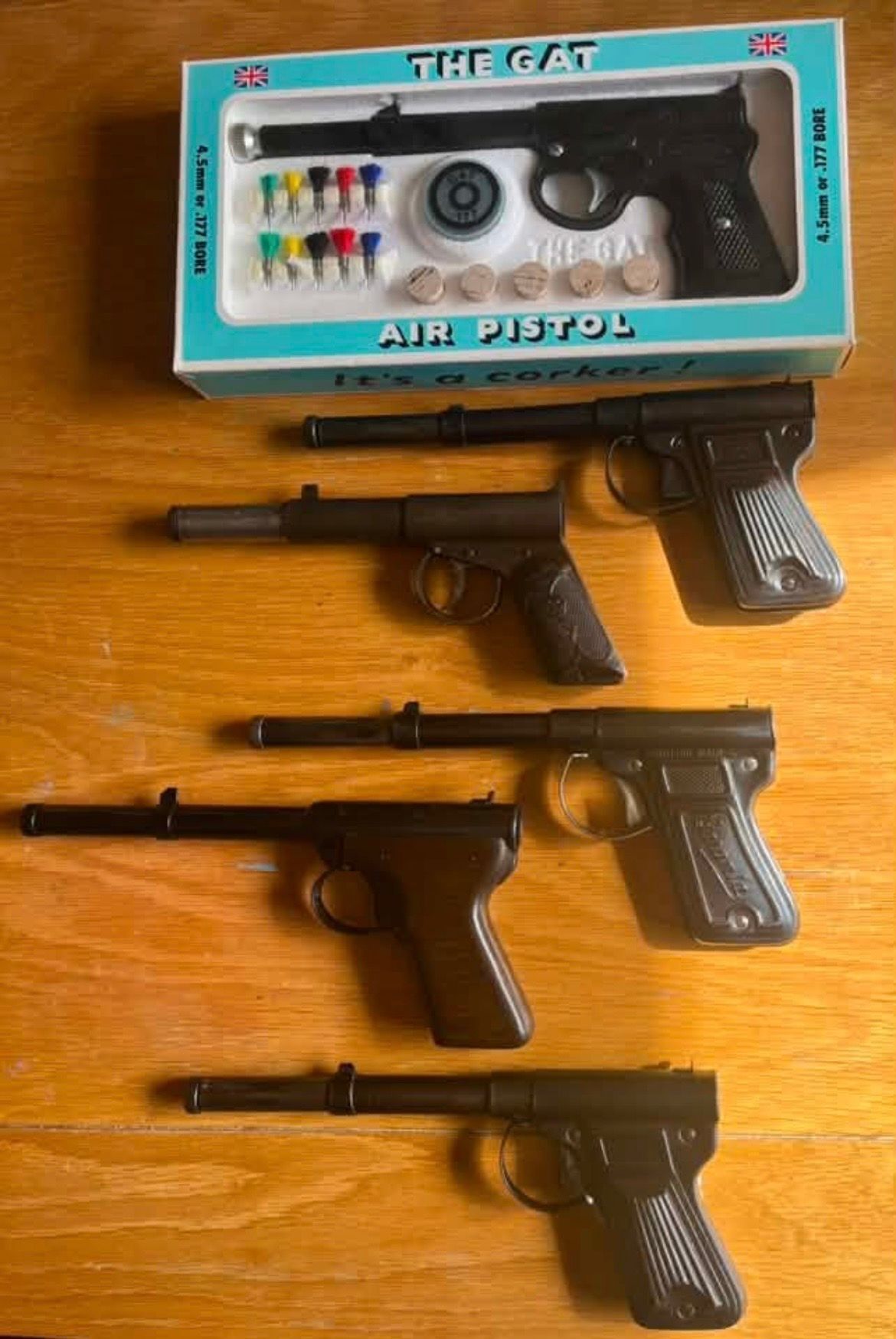
Pop outs a general description. When collectors think about vintage air pistols, the mind often turns to names such as Webley, BSA, Diana or Haenel. But alongside these better-known makes was another fascinating group of air pistols that were produced specifically to be simple, inexpensive and accessible – the pop-out or push-barrel air pistols. Often referred to generically as “Gat-type” pistols, these little airguns used a distinctive operating principle in which the barrel, or an inner barrel section, moved forwards when the pistol was fired. To many people they looked more like a toy than a serious air pistol, and that reputation has followed them throughout their history. For collectors today. However, they represent an interesting and sometimes surprisingly diverse part of airgun history. The history of the push-barrel air pistol goes back much further than the familiar post-war GAT. One of the important early influences was the Quackenbush push-barrel design, dating from the late 19th century. The principle subsequently appeared in a number of European and British air pistols. The history of Diana is particularly interesting. Mayer & Grammelspacher was established at Rastatt in 1890, and the company's first air pistol is generally dated to 1892, before the Diana name itself was adopted in 1905. The company's early development was closely connected with the German airgun industry and with Eisenwerke Gaggenau, where Jakob Mayer and Josef Grammelspacher had previously worked. This makes some of the very early German pistols particularly interesting to collectors, as they sit right at the beginning of the development of the inexpensive spring-powered air pistol. The Main Names. Over the years, the pop-out principle appeared under a surprisingly large number of names. Among the better-known manufacturers and models are: Diana, T.J. Harrington – The GAT, Briton, Briton De-Luxe, Super Briton, British Cub, Garanta, MK, Eisenwerke Gaggenau, Dolla / William Tell, Limit and Hy-Score. The British GAT became perhaps the best-known example of the type. T.J. Harrington's GAT was introduced in 1937, with production interrupted during the Second World War before resuming afterwards. It remained in production for many years and became one of the most familiar inexpensive air pistols in Britain. The GAT's simple die-cast construction, low price and unusual appearance undoubtedly contributed to its enormous popularity. It became an introduction to airguns for generations of youngsters and recreational shooters. The British Government's historical work on pre-1939 air pistols also identifies a significant group of push-in, spring-loaded barrel pistols, including the Briton, Briton De-Luxe, Super Briton, Dolla, Diana Model 2 and Limit. The Rarer Examples. For today's collector, the most interesting part of the story is perhaps not the common GAT, but the less frequently encountered pistols. Names such as Garanta, British Cub, MK, Briton and Eisenwerke Gaggenau can attract considerably more interest simply because examples are encountered far less frequently. Some of these pistols can be difficult to identify with certainty. Different manufacturers, distributors and retailers sometimes marketed very similar mechanisms under different names, while model numbers and markings can vary considerably. This is where original catalogues, period advertisements and surviving examples become particularly important. The Eisenwerke Gaggenau connection is especially interesting. The company's early airgun production forms part of the background to the development of Mayer & Grammelspacher, and the early Gaggenau and MGR designs show how closely related some of these early German air pistols could be. Consequently, a pistol that initially appears to be nothing more than an inexpensive old airgun can sometimes have considerably more historical interest than its appearance suggests. Why Were They So Inexpensive? The answer is largely simplicity. The pop-out design avoided some of the more complicated mechanisms found on conventional spring-powered air pistols. Cheap castings, relatively few components and straightforward construction helped manufacturers keep production costs down. The GAT is an excellent example. Its frame and barrel assembly were largely produced from die-cast material, with later versions incorporating some plastic components. More expensive plated examples were also produced, and these can be considerably less common today. The result was an air pistol that could be sold relatively cheaply and used for casual shooting, plinking, darts and, in some versions, cork shooting. The Price of Simplicity – Shooting Performance. The same simplicity that made these pistols inexpensive also created their biggest weakness. They were never designed to compete with a quality target air pistol. The moving barrel is particularly important. When the pistol fires, the barrel or inner barrel section moves forward. That movement does nothing to help achieve the consistent shot-to-shot stability required for serious accuracy. The GAT is a good example. Contemporary and historical accounts generally regard it as a low-powered and relatively inaccurate pistol, with the moving barrel contributing to the characteristic shooting behaviour. This is not necessarily a criticism, these pistols were designed for inexpensive recreational shooting rather than precision target work. Their appeal was their simplicity, unusual operation and sheer fun. Maintenance – Simple to Look At, Not Always Simple to Work On. One of the great misconceptions about these pistols is that, because they look simple, they must be simple to repair. That is not always the case. Many old pop-out pistols have now been sitting unused for decades. Springs can have weakened, seals can have hardened or deteriorated, lubrication can have dried out and corrosion can develop inside areas that cannot be seen externally. The end nut and spring assembly is another important consideration. On many examples the main spring is under considerable tension, meaning that dismantling should not be treated as a casual job simply because the pistol is small. A collector buying one as a restoration project should therefore resist the temptation to dismantle an unfamiliar example without first understanding its construction. Replacement seals, springs and small components can also be difficult to source for the rarer makes. This is one reason why an apparently inexpensive pistol can sometimes become a surprisingly involved restoration project. For collectors, originality can also be important. A crude repair may make an old pistol functional, but it can reduce its historical and collector interest. Why Were They Often Seen as Toys? There is another fascinating side to the pop-out air pistol story. The combination of a small size, low power, simple operation and inexpensive construction gave many of these pistols the appearance of a toy. The GAT in particular became closely associated with childhood shooting and recreational use. Historical accounts describe it as an introduction to airguns for generations of young shooters. That perception is understandable, but it can also cause modern collectors to underestimate these pistols. They were genuine airguns with mechanical compression systems, not merely toys. The fact that some were marketed for amusement, darts or cork shooting does not remove their place in airgun history. A First Introduction to Airguns. For many older collectors, this is perhaps the most nostalgic part of the story. A cheap pop-out pistol could be the first airgun that a youngster was able to handle. For some, it was the beginning of a lifelong interest in airguns. Today, however, it is useful to separate historical nostalgia from modern expectations. What was once regarded as an inexpensive introduction to shooting is now principally interesting as a piece of mechanical and social history. Collectors may remember their first GAT, Briton or similar pistol with great affection, even though the pistol itself may have little practical value as a precision shooting instrument. That nostalgia is an important part of collecting. The value of these little pistols is therefore not necessarily found in their power or accuracy. It can be found in their history, rarity, originality, mechanical design and the memories associated with them. Collecting the Cheaper Pop-Out Pistols. The inexpensive end of the vintage air-pistol market can be particularly rewarding because it allows collectors to explore models that are often overlooked. A common GAT may not command the same prices as a scarce early German or British pistol, but unusual variations, original finishes, unusual markings and scarce manufacturers can completely change the picture. For the collector, condition and originality remain important, but so does rarity. A little-known maker producing a relatively small number of pistols may ultimately prove more interesting than a far more common model simply because examples rarely turn up. The next time you see an old pop-out air pistol that looks more like a toy than a serious airgun, it is therefore worth taking a second look. It may represent one of the simplest forms of spring-powered airgun engineering – but behind that simplicity is a history stretching back well over a century. Angel Air Parts – preserving the parts, history and knowledge behind classic air guns.
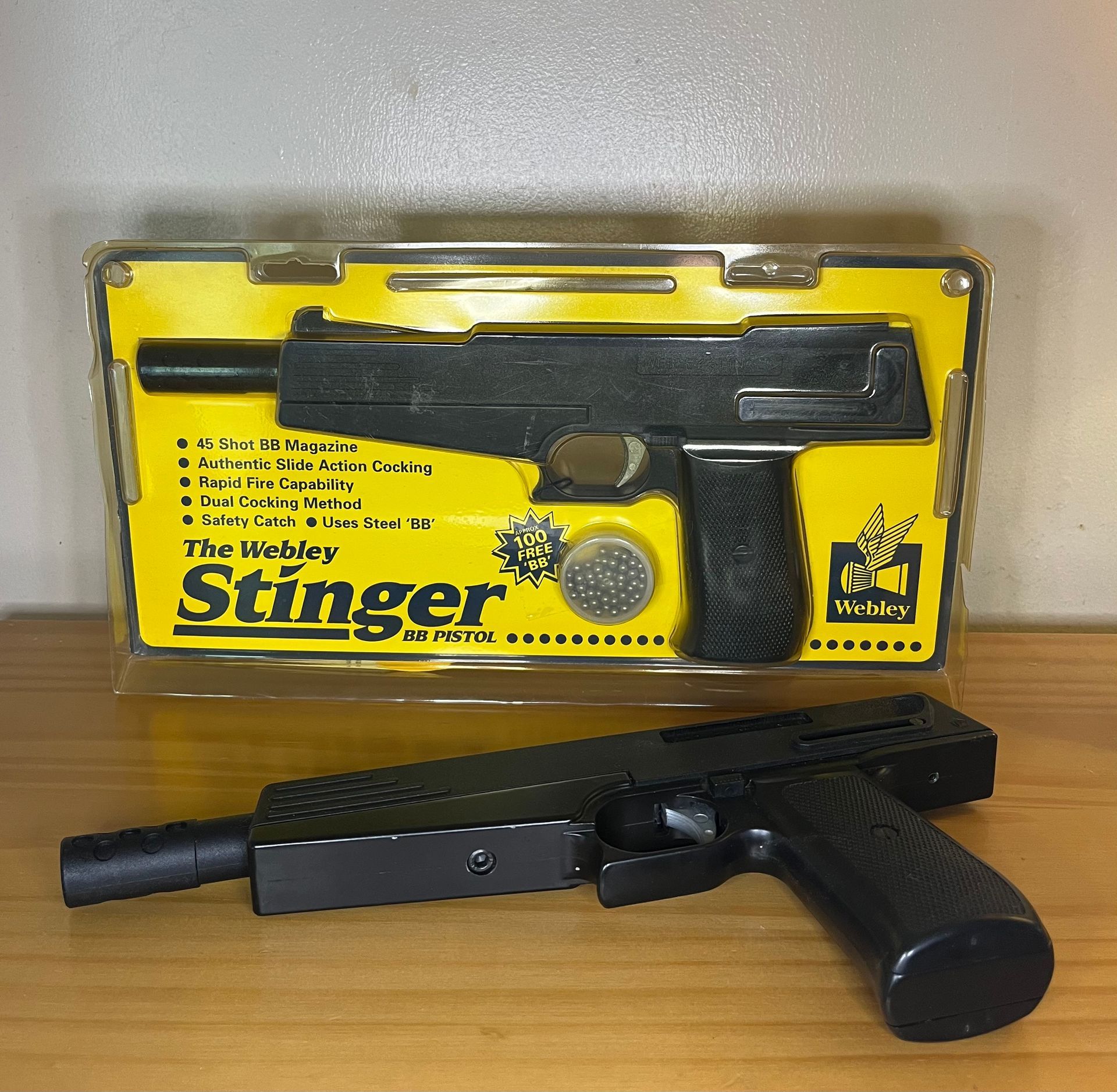
Yellow and black boxed toy “Stinger” gun with a black toy pistol lying in front on a table.
By Paul Angel • September 24, 2026
Webley Stinger Air Pistol Collectors Reference Guide. The Webley Stinger is one of the most unusual pistols to come from Webley’s Birmingham factory from 1996 to 2005 and, arguably, one of the most overlooked. Produced during the final years of Birmingham Webley airgun production, the Stinger represented a dramatic departure from the company's traditional air pistol designs. Its modern appearance and recreational purpose were a long way removed from the classic Senior, Premier, Hurricane and Tempest. The Stinger was essentially designed a s a fun, recreational air pistol, rather than a serious target pistol, and is believed by some to have been Webley's answer to the increasing number of inexpensive imported air pistols appearing on the market. Today, its unusual design makes it an interesting part of Webley history. Shooting and Ammunition. Unlike most traditional Webley air pistols, the Stinger uses .177 steel BB ammunition rather than conventional lead pellets. Its smoothbore barrel and BB magazine make it quite different from a typical pellet-firing Webley. This also explains much of the pistol's character. The Stinger was designed for informal shooting and plinking rather than precision target work. Collectors should remember that the Stinger's loading, cocking and firing system is quite different from conventional Webley spring-piston pistols, and it should be maintained acordingly. Maintenance. The Stinger's unusual slide mechanism is one of the main areas to inspect on an older example. The slide should operate smoothly and without excessive resistance, grinding or binding. Dirt, corrosion and old dried lubricant can all affect its operation. Particular attention should be given to: Slide and cocking mechanism Internal spring and seals Magazine and BB loading system Wear around moving components Signs of corrosion or excessive lubrication As with any vintage spring-powered air pistol, an example that has been stored for many years should not simply be repeatedly cocked and fired to see whether it works. Old springs, seals and other internal components can deteriorate with age and may require inspection before use. The original black epoxy-type finish should also be treated carefully. Aggressive polishing or attempts to re-blue the pistol can permanently damage its original finish. Gentle cleaning and appropriate protection are preferable. Black and Silver Versions. The standard Stinger was finished in black, but by approximately 1998 a silver version was also available. The silver paint was applied to the metal portions of the pistol and gives the Stinger a very different appearance. It has similarities to some of the silver-finished special-edition Nemesis and Pony Club models produced during the same period. Both finishes are of interest to collectors, particularly when accompanied by original packaging. There is a rumour of an orange version, but this is unconfirmed. The Original Clam-Pack. The Stinger was supplied in a distinctive clear plastic clam-pack. Unfortunately, these packages have not always aged particularly well. Prolonged exposure to ultraviolet light can cause the plastic to become yellow, cloudy, brittle or cracked. Consequently, an original Stinger still in its clam-pack is increasingly interesting to collectors. Even discolouration can be regarded as part of the packaging's age and history rather than necessarily indicating that it is not original. The Final Birmingham Webleys. The Stinger has an important place in Webley history because it belongs to the final generation of air pistols produced in England. The Hurricane, Tempest, Nemesis and Stinger were among the last Webley air pistols produced in Birmingham, with English production ending in December 2005 . For many years the Stinger was largely overlooked because of its radical appearance and its departure from traditional Webley design. However, some collectors are now beginning to appreciate these final Birmingham models for their historical importance and potential future rarity. Collector's Summary. The Stinger may never have the traditional appeal of a pre-war Webley or a classic Senior or Premier, but it represents something equally important—the end of an era. Its unusual BB-firing system, distinctive design, alternative nickel finish, vulnerable original packaging and position within the final years of Birmingham production make it a fascinating Webley to preserve. For collectors of Webley air pistols, the Stinger should perhaps be viewed not as an oddity, but as the final chapter in the story of British-made Webley air pistols. Angel Air Parts – preserving the parts, history and knowledge behind classic air guns.
By Paul Angel • September 17, 2026
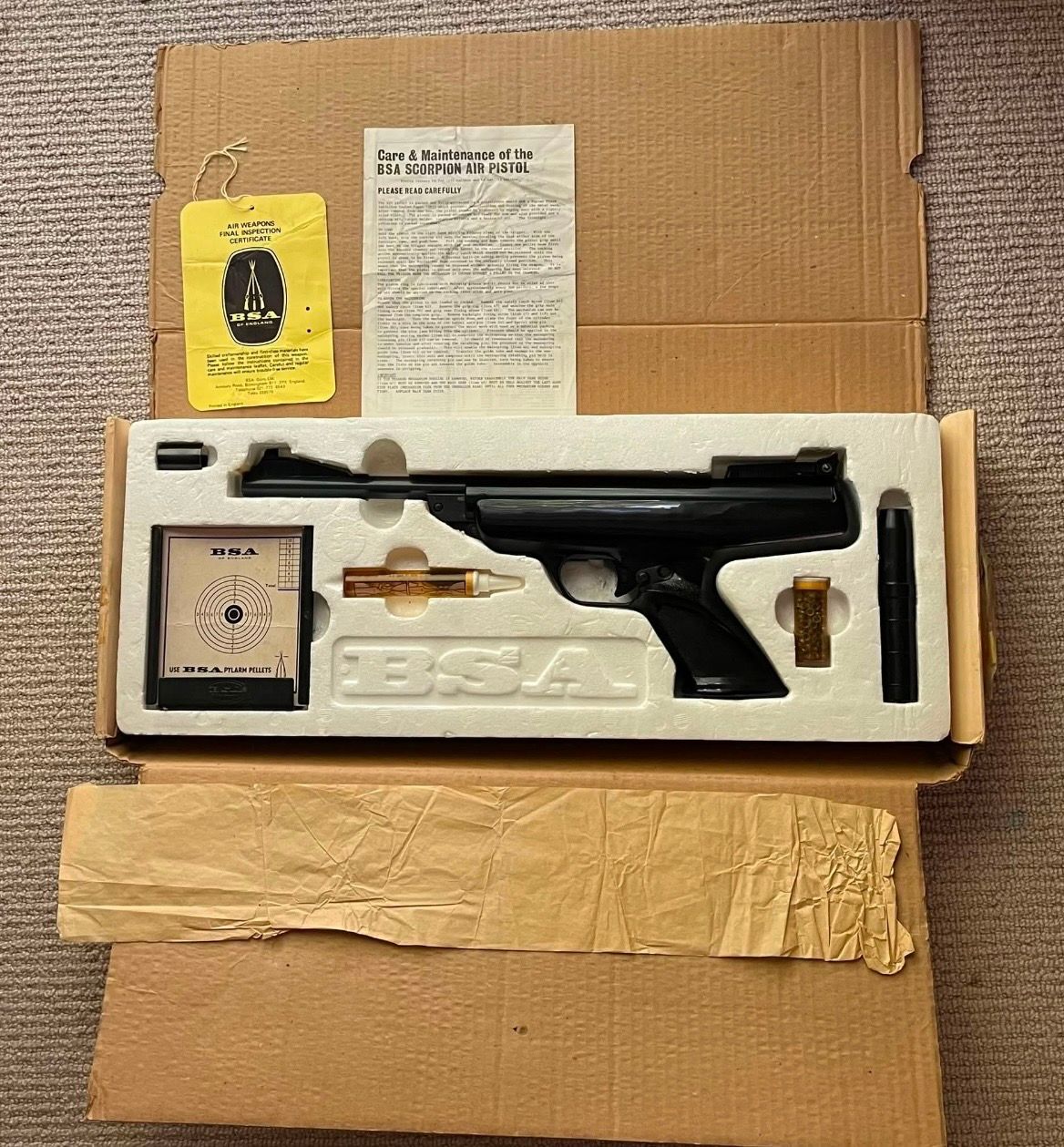
Collector's Quick Reference Guide. The BSA Scorpion was introduced in 1973, although full-scale production is generally regarded as beginning around 1977. Production continued until 1992. A large, heavy spring-powered, break-barrel pistol, the Scorpion was produced mainly in .177 and .22 calibre and underwent several changes during its production life. For anyone interested in these pistols, the small differences between early and later examples are particularly interesting. Early Scorpions. The earliest examples are especially interesting because they differ from later pistols in several respects. Features to look for include: Early examples can be found with smoothbore barrels. Early pistols generally had no scope rail. Early sight arrangements differ from later examples. Early serial-number prefixes include PA (.177) and RA (.22). Later .22 examples include the RB prefix. Some early .22 Scorpions were recalled and modified because of power levels exceeding the UK air-pistol limit applicable at the time. Important: A serial prefix should not be used on its own to determine the specification or current power of a surviving pistol. Mk1 Scorpion. The Mk1 changed during its production period, so not every Mk1 will have exactly the same specification. Typical early Mk1 characteristics include: No scope rail on the earliest examples, Open sights, Spring-piston action, Break-barrel loading, Automatic safety, Large moulded black plastic grip/stock, Black-finished metalwork, Later Mk1 examples incorporated some features associated with the later pistol, making the distinction between late Mk1 and Mk2 less straightforward than it first appears. Mk2 Scorpion. The later Scorpion specification became established during the 1980s, with production continuing until approximately 1992. The most obvious change is the factory-machined scope rail. Other changes can include differences in: Sights, Safety components, Trigger components, Internal parts, Finish, Serial-number prefixes. Because components can have been replaced during the pistol's lifetime, individual examples do not always conform perfectly to their original specification. Scope Rails. The absence or presence of a scope rail is one of the easiest external differences to spot. Early examples, No factory scope rail. Later examples, Machined dovetail scope rail. However, the scope rail should not be regarded as an absolute Mk1/Mk2 identification method, as later Mk1 and transitional examples can complicate the picture. Power. Power is an important part of the Scorpion's history. Some early .22 examples developed a reputation for exceeding the UK air-pistol power limit and were subsequently recalled for modification. With surviving examples now many decades old, however, the current power of an individual pistol cannot be reliably established from its age, model or serial number. Spring, seal and piston condition can all affect performance. Original Packaging & Accessories. A complete boxed Scorpion is particularly interesting. Original accessories and packaging can include: Cardboard outer box, Polystyrene internal tray, Plastic cocking aid, Front sight hood, Target holder/pellet catcher, Target cards, Pellet container, Oil, Instruction leaflet and Test card. Packaging and accessories changed over the production period, so surviving original items can provide useful clues when researching an individual example. Common Maintenance Problems. After more than 30 years, the condition of the internal components is often more important than the external appearance. Piston Seal & Buffer. One of the most common problems encountered with an old Scorpion is deterioration of the piston seal and buffer components. With age, these materials can: Break down, Become brittle, Swell, Disintegrate, Interfere with piston movement. Deteriorated material can cause the piston to become stiff or even jam inside the cylinder. An untouched Scorpion that has been stored for many years should therefore be inspected rather than simply cocked and fired. Trigger Mechanism. The Scorpion trigger mechanism is relatively complicated compared with many other vintage spring-powered air pistols. It contains several interacting components, springs and sear parts, and care is required when dismantling it. The trigger is adjustable, but access to the adjustment mechanism is not particularly straightforward. For anyone servicing a Scorpion, keeping the trigger components organised and recording their position during dismantling is strongly recommended. Lubrication. Old Scorpions should not simply be flooded with oil. The piston assembly contains rubber and synthetic components that can deteriorate or react adversely to unsuitable lubricants. A sensible approach is to clean, inspect and lubricate only the appropriate areas, rather than applying excessive oil throughout the mechanism. Black Plastic Grip/Stock. The Scorpion's moulded black plastic grip/stock is one of its most recognisable features. After decades of use and storage, examples can suffer from: Scratches, Scuffing, Dull or faded areas, Damage around the grip, Cracks or distortion. When servicing a Scorpion, the original plastic should be treated carefully. Aggressive polishing, abrasives or unsuitable solvents can permanently alter the original surface finish. Where possible, retaining the original plastic and its period appearance is preferable to attempting to make an older pistol look new. A Classic BSA. The BSA Scorpion is an excellent example of why vintage airguns should be examined by their individual features rather than simply by model name. From the early smoothbore examples through the developing Mk1 specification and into the later Mk2 pistols, the Scorpion underwent numerous small changes before production finally ended in 1992. For anyone interested in these pistols, those small differences are what make the Scorpion such an interesting part of British airgun history. Angel Air Parts – preserving the parts, history and knowledge behind classic air guns 
Hand holding a magnifying glass against a softly blurred sunset sky
By Paul Angel • July 24, 2026
Parts Due in or yet to be assessed or checked.
By Paul Angel • July 21, 2026
Cold bluing is a simple and cost-effective way to restore the appearance of worn steel parts on air rifles and air pistols. While it will not be as durable as a professional hot-blued finish, it can produce excellent results when applied carefully and patiently. Items You'll Need Cold bluing solution or gel. Degreaser (acetone works well). Fine wire wool (0000 grade). Clean cloths or paper towels. Nitrile gloves. Rust and blue remover (optional). Air gun or gun oil. Fine abrasive paper (240–1200 grit). Step 1 – Prepare the Metal Remove the existing finish using fine abrasive paper. If the metal has scratches or heavy corrosion, start with around 240-grit paper and gradually work up through finer grades, finishing with 600 to 1200 grit. Sand lengthways along the metal wherever possible. This produces a smoother, more traditional finish and helps avoid visible sanding marks. Ensure all rust, pitting residue, and old bluing have been removed before moving on. Step 2 – Degrease Thoroughly Using acetone and clean paper towels, wipe the bare metal until no dirt, oil, or dark residue remains. Any grease left on the surface can prevent the bluing solution from working properly. Step 3 – Warm the Metal Gently warm the metal using an oven, heat gun, or hair dryer until it feels hot to the touch but not excessively hot. Warming the metal helps the bluing solution react more evenly and can improve the final finish. Step 4 – Final Clean Give the warmed metal one final wipe with acetone to remove any fingerprints, dust, or contamination that may have appeared during handling. Step 5 – Apply the Bluing Solution Pour a small amount of cold bluing solution into a separate clean container. Never dip applicators directly into the original bottle, as contamination can reduce the effectiveness of the product. Using a cotton swab, cotton pad, or clean applicator, apply an even coat over the metal surface. Step 6 – Allow the Reaction to Work Leave the solution on the metal for the time recommended by the manufacturer, typically between one and three minutes. A grey or dark residue may appear on the surface. Once the reaction is complete, gently rub the metal with 0000-grade wire wool to smooth the finish. For a deeper colour, several light applications are usually better than one heavy application. Step 7 – Neutralise and Dry Rinse the metal thoroughly with cold water to stop the chemical reaction. Dry the surface completely using clean paper towels or a lint-free cloth. Once dry, lightly buff the metal with 0000-grade wire wool to remove any haze or uneven residue. Step 8 – Oil the Finish When you are satisfied with the colour and appearance, generously coat the metal with air gun or gun oil. Allow the oil to soak into the newly blued surface overnight. The following day, wipe away any excess oil with a clean cloth. This final step helps protect the finish and improves its durability. Safety Notes Cold bluing products contain chemicals that can be harmful if used incorrectly. Always work outdoors or in a well-ventilated area. Wear nitrile gloves and safety goggles at all times. Avoid skin and eye contact with the solution. Keep products away from children and pets. Protect work surfaces from spills by using a disposable, non-absorbent covering. Always follow the manufacturer's instructions supplied with your chosen bluing product. Final Thoughts Cold bluing is an excellent skill for collectors, restorers, and enthusiasts who want to improve the appearance of vintage air guns. The key to success is preparation. Taking extra time to remove rust, polish the metal, and thoroughly degrease the surface will usually have a greater impact on the final result than the bluing solution itself. Remember, patience produces the best finish. Angel Air Parts – preserving the parts, history and knowledge behind classic air pistols. 
By Paul Angel • July 10, 2026
A Beginner's Guide to Renovating Wooden Air Rifle and Air Pistol Stocks.
By Paul Angel • July 7, 2026
5 Common Problems Found in Vintage Spring-Powered Air Rifles and Pistols