The Cheaper Pop-Out Air Pistols – Small Guns with a Big History
Pop outs a general description.
When collectors think about vintage air pistols, the mind often turns to names such as Webley, BSA, Diana or Haenel. But alongside these better-known makes was another fascinating group of air pistols that were produced specifically to be simple, inexpensive and accessible – the pop-out or push-barrel air pistols. Often referred to generically as “Gat-type” pistols, these little airguns used a distinctive operating principle in which the barrel, or an inner barrel section, moved forwards when the pistol was fired. To many people they looked more like a toy than a serious air pistol, and that reputation has followed them throughout their history.
For collectors today.
However, they represent an interesting and sometimes surprisingly diverse part of airgun history. The history of the push-barrel air pistol goes back much further than the familiar post-war GAT. One of the important early influences was the Quackenbush push-barrel design, dating from the late 19th century. The principle subsequently appeared in a number of European and British air pistols.
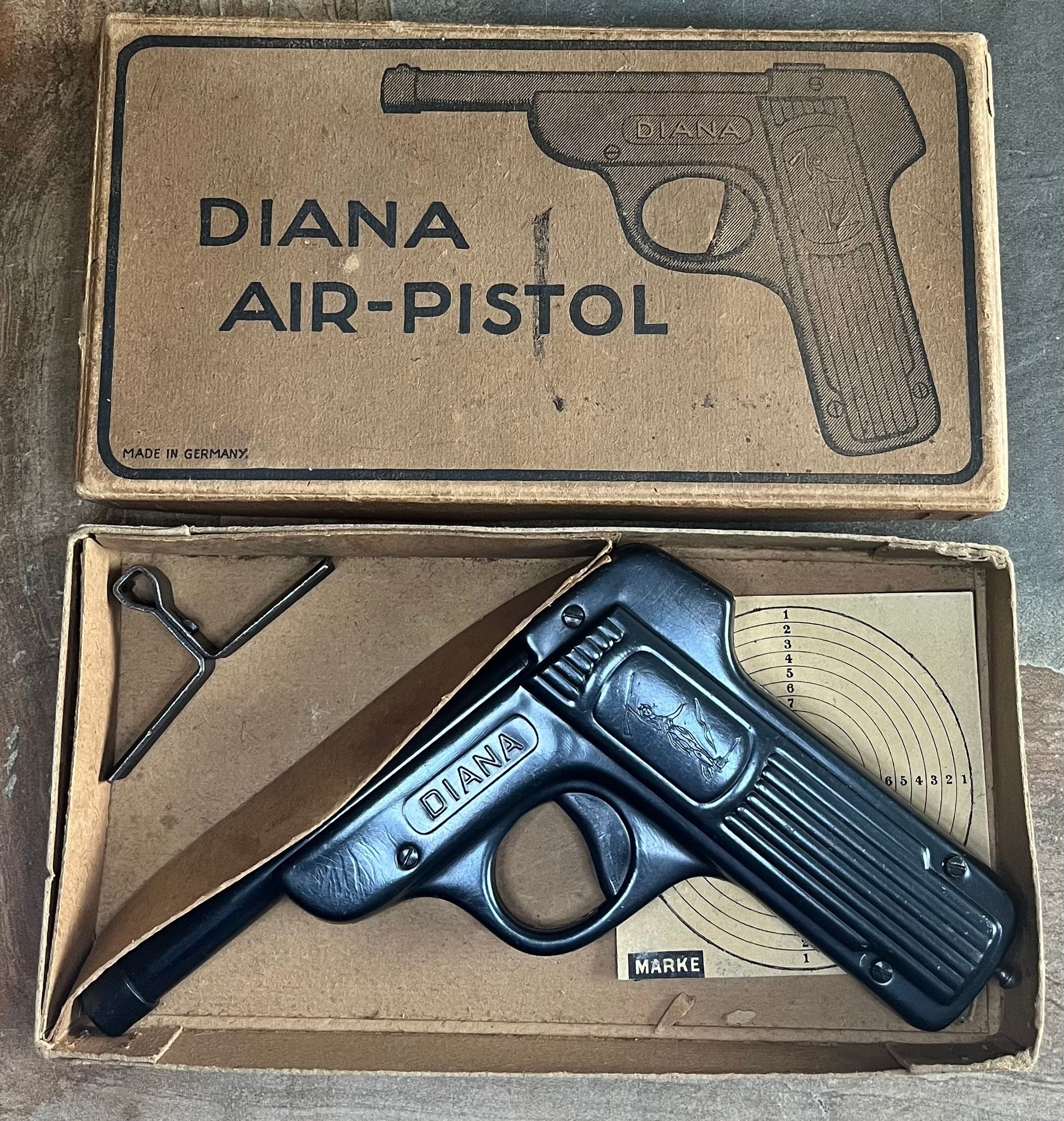
The history of Diana is particularly interesting. Mayer & Grammelspacher was established at Rastatt in 1890, and the company's first air pistol is generally dated to 1892, before the Diana name itself was adopted in 1905. The company's early development was closely connected with the German airgun industry and with Eisenwerke Gaggenau, where Jakob Mayer and Josef Grammelspacher had previously worked. This makes some of the very early German pistols particularly interesting to collectors, as they sit right at the beginning of the development of the inexpensive spring-powered air pistol.
The Main Names.
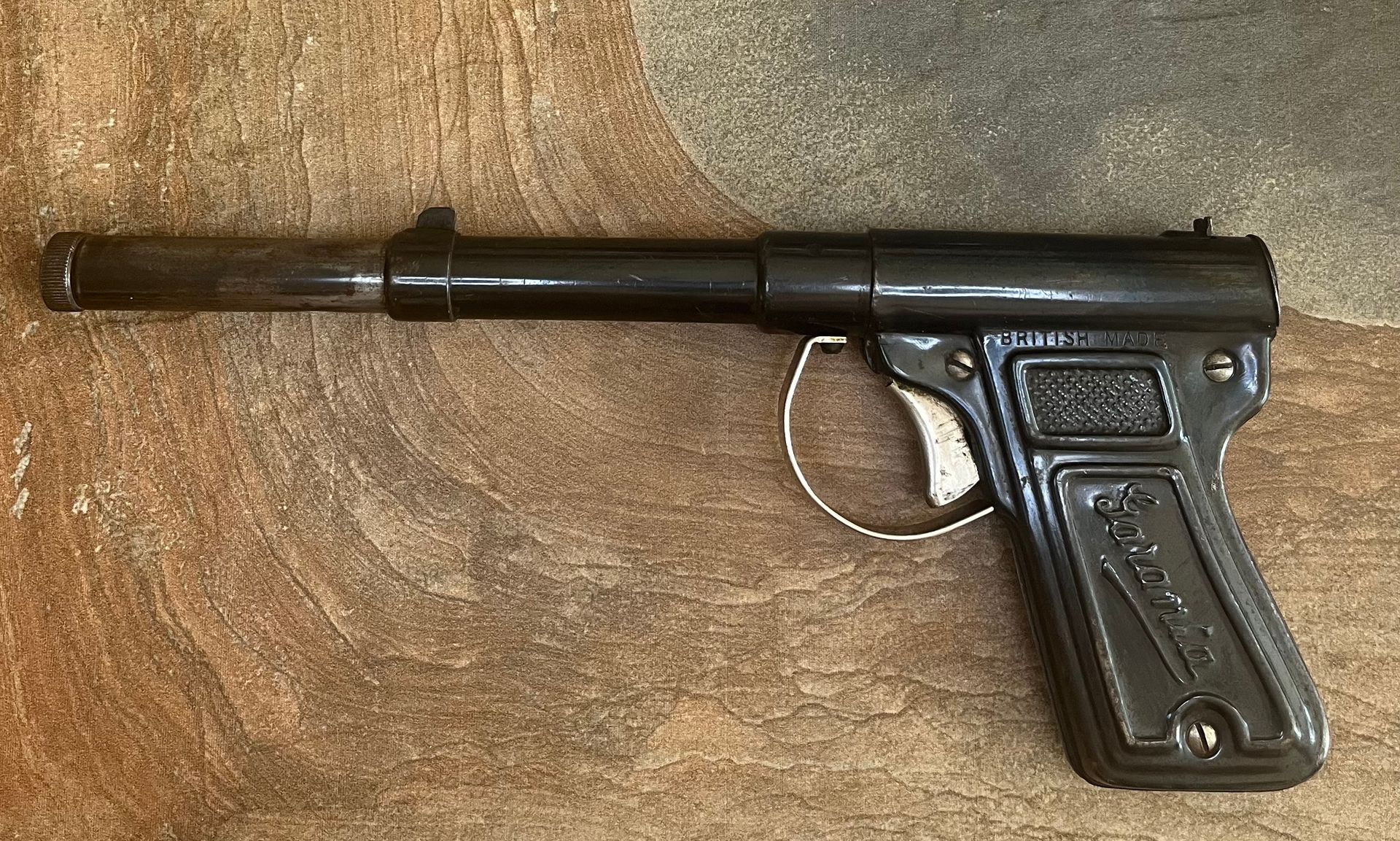
Over the years, the pop-out principle appeared under a surprisingly large number of names. Among the better-known manufacturers and models are: Diana, T.J. Harrington – The GAT, Briton, Briton De-Luxe, Super Briton, British Cub, Garanta, MK, Eisenwerke Gaggenau, Dolla / William Tell, Limit and Hy-Score.
The British GAT became perhaps the best-known example of the type. T.J. Harrington's GAT was introduced in 1937, with production interrupted during the Second World War before resuming afterwards. It remained in production for many years and became one of the most familiar inexpensive air pistols in Britain. The GAT's simple die-cast construction, low price and unusual appearance undoubtedly contributed to its enormous popularity. It became an introduction to airguns for generations of youngsters and recreational shooters.
The British Government's historical work on pre-1939 air pistols also identifies a significant group of push-in, spring-loaded barrel pistols, including the Briton, Briton De-Luxe, Super Briton, Dolla, Diana Model 2 and Limit.
The Rarer Examples.
For today's collector, the most interesting part of the story is perhaps not the common GAT, but the less frequently encountered pistols.
Names such as Garanta, British Cub, MK, Briton and Eisenwerke Gaggenau can attract considerably more interest simply because examples are encountered far less frequently. Some of these pistols can be difficult to identify with certainty. Different manufacturers, distributors and retailers sometimes marketed very similar mechanisms under different names, while model numbers and markings can vary considerably. This is where original catalogues, period advertisements and surviving examples become particularly important.
The Eisenwerke Gaggenau connection is especially interesting. The company's early airgun production forms part of the background to the development of Mayer & Grammelspacher, and the early Gaggenau and MGR designs show how closely related some of these early German air pistols could be. Consequently, a pistol that initially appears to be nothing more than an inexpensive old airgun can sometimes have considerably more historical interest than its appearance suggests.
Why Were They So Inexpensive?
The answer is largely simplicity. The pop-out design avoided some of the more complicated mechanisms found on conventional spring-powered air pistols. Cheap castings, relatively few components and straightforward construction helped manufacturers keep production costs down. The GAT is an excellent example. Its frame and barrel assembly were largely produced from die-cast material, with later versions incorporating some plastic components. More expensive plated examples were also produced, and these can be considerably less common today. The result was an air pistol that could be sold relatively cheaply and used for casual shooting, plinking, darts and, in some versions, cork shooting.
The Price of Simplicity – Shooting Performance.
The same simplicity that made these pistols inexpensive also created their biggest weakness. They were never designed to compete with a quality target air pistol. The moving barrel is particularly important. When the pistol fires, the barrel or inner barrel section moves forward. That movement does nothing to help achieve the consistent shot-to-shot stability required for serious accuracy.
The GAT is a good example. Contemporary and historical accounts generally regard it as a low-powered and relatively inaccurate pistol, with the moving barrel contributing to the characteristic shooting behaviour. This is not necessarily a criticism, these pistols were designed for inexpensive recreational shooting rather than precision target work. Their appeal was their simplicity, unusual operation and sheer fun.
Maintenance – Simple to Look At, Not Always Simple to Work On.
One of the great misconceptions about these pistols is that, because they look simple, they must be simple to repair. That is not always the case. Many old pop-out pistols have now been sitting unused for decades. Springs can have weakened, seals can have hardened or deteriorated, lubrication can have dried out and corrosion can develop inside areas that cannot be seen externally. The end nut and spring assembly is another important consideration. On many examples the main spring is under considerable tension, meaning that dismantling should not be treated as a casual job simply because the pistol is small.
A collector buying one as a restoration project should therefore resist the temptation to dismantle an unfamiliar example without first understanding its construction. Replacement seals, springs and small components can also be difficult to source for the rarer makes. This is one reason why an apparently inexpensive pistol can sometimes become a surprisingly involved restoration project. For collectors, originality can also be important. A crude repair may make an old pistol functional, but it can reduce its historical and collector interest.
Why Were They Often Seen as Toys?
There is another fascinating side to the pop-out air pistol story. The combination of a small size, low power, simple operation and inexpensive construction gave many of these pistols the appearance of a toy. The GAT in particular became closely associated with childhood shooting and recreational use. Historical accounts describe it as an introduction to airguns for generations of young shooters.
That perception is understandable, but it can also cause modern collectors to underestimate these pistols.
They were genuine airguns with mechanical compression systems, not merely toys. The fact that some were marketed for amusement, darts or cork shooting does not remove their place in airgun history.
A First Introduction to Airguns.
For many older collectors, this is perhaps the most nostalgic part of the story. A cheap pop-out pistol could be the first airgun that a youngster was able to handle. For some, it was the beginning of a lifelong interest in airguns. Today, however, it is useful to separate historical nostalgia from modern expectations. What was once regarded as an inexpensive introduction to shooting is now principally interesting as a piece of mechanical and social history.
Collectors may remember their first GAT, Briton or similar pistol with great affection, even though the pistol itself may have little practical value as a precision shooting instrument. That nostalgia is an important part of collecting. The value of these little pistols is therefore not necessarily found in their power or accuracy. It can be found in their history, rarity, originality, mechanical design and the memories associated with them.
Collecting the Cheaper Pop-Out Pistols.
The inexpensive end of the vintage air-pistol market can be particularly rewarding because it allows collectors to explore models that are often overlooked. A common GAT may not command the same prices as a scarce early German or British pistol, but unusual variations, original finishes, unusual markings and scarce manufacturers can completely change the picture. For the collector, condition and originality remain important, but so does rarity. A little-known maker producing a relatively small number of pistols may ultimately prove more interesting than a far more common model simply because examples rarely turn up.
The next time you see an old pop-out air pistol that looks more like a toy than a serious airgun, it is therefore worth taking a second look. It may represent one of the simplest forms of spring-powered airgun engineering – but behind that simplicity is a history stretching back well over a century.
Angel Air Parts – preserving the parts, history and knowledge behind classic air guns.